Saint Hubert’s
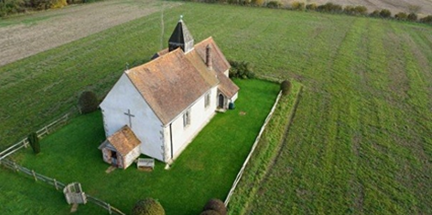
St. Hubert’s is a Grade 1 Listed Building which dates from at least 1053. It is situated on a hillside and in the middle of a field in the attractive natural landscape of the Idsworth Valley within the South Downs National Park. The features of the building and its fittings are remarkably unspoilt and include important medieval wall paintings.
St Hubert’s is open every day from 9.00 am until 6.00 pm from 1st April until 30th September and from 9.00 am until 4.00 pm from 1st October until 31st March.
Times of Services and Events for Saint Hubert’s and the Benefice
The church service times are shown on the Welcome page for Saint Hubert’s and the other churches in the Benefice.
Details of all the events at Saint Hubert’s and the other churches in the Benefice can be found on the News & Events page.
Music at Saint Hubert’s
‘One Word, Many Notes’ is a concert series built around a beautifully simple idea: that one word can open the door to a whole world of music. Each evening takes a single word and brings it to life through performances by exceptional musicians. We can look forward to an evening focussed on friendship through the music of, amongst others, Mozart and a piece composed especially for the group inspired by ‘Lines Written in Early Spring’ by William Wordsworth. Full details can be found on the music website.
Launch of a new film about Saint Hubert’s
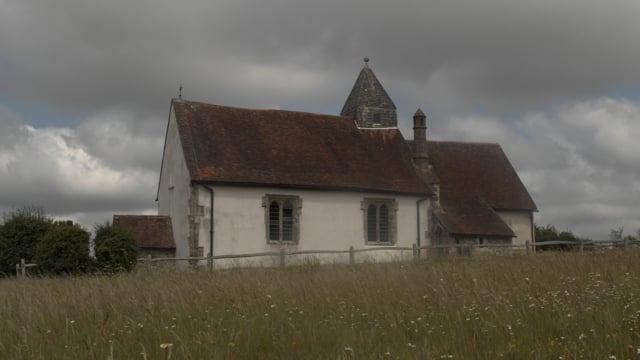
The film tells the story, in an exciting and holistic approach, about this special church and its surroundings.
One of Hampshire’s oldest churches – St Hubert’s at Idsworth – is now using modern technology to tell its fascinating story for all its many visitors to enjoy. Accessible by a QR code at the church, the 20-minute film is the result of a collaborative project between the Parochial Church Council of St Hubert’s and the University of Portsmouth’s Heritage Hub.
The film looks at the rich history of the location and the present, almost 1,000-year-old, church building, with its nationally important wall paintings, alongside landscape, archaeology, people, usage and conservation. “The film aims, and has the capacity, to raise awareness and communicate key narratives of this significant historic site to local, national and international audiences.”
Community
St. Hubert’s has strong links with its local community and it also welcomes many visitors – some travel long distances to feel part of its history and culture whilst others stop by on the popular walking route which passes alongside.
The Parochial Church Council (PCC) actively encourages widening community engagement and, on this and in relation to its repair and conservation programme, it has the valued support of The Friends of the Church of St Hubert’s Idsworth Trust, a separate charity which was formed in 2016.
History
St. Hubert’s is a Saxo-Norman church. The history of the present building goes back to at least 1053 when, in the last testament of Godwin, Earl of Wessex, and as part of the Manor of Chalton, it was granted to his son, Harold Godwinson (later King Harold). However, archaeological evidence indicates that there may have been a much earlier stone structure on the site which would not be surprising given it is known that there has been human activity in the Idsworth Valley since prehistoric times.
The church is renowned for its beautiful simplicity and a distinctive feature is the legibility of its development over the centuries. The C11 nave has a small Norman window and a blocked Norman doorway and there is an incised medieval sundial on the exterior. The chancel was added in the 12C or 13C; the nave was widened on the south side in the early 16C and first evidence of the porch was in the 1860s. The vestry and the organ gallery were added in 1912-1913 during a major restoration under the direction of the Architect H S Goodhart-Rendel when the intricate plaster ceiling in the chancel was also formed.
Among the historical features within the church are the medieval wall paintings which have been dated to the 1330s and which are considered to be the most important series in a Hampshire church outside Winchester. Other notable features are a C14 octagonal font, a C17 pulpit and C18 canopy and C18 box pews. On the walls, there is a list of the Rectors of Chalton and Idsworth going back to 1305, a record of a meeting which was held in March 1795 to agree seating arrangements within the church and, on the inner face of the chancel arch, there is reference to repairing work having been undertaken in 1793 and 1824 with a painted Royal Coat of Arms of George III.
The church was originally dedicated to St. Peter and St. Paul but the dedication was changed when the medieval wall paintings were discovered in the 1860s as it was thought, then, that the upper panel referred to the life of St. Hubert. It is now considered that it depicts the life of St. John the Baptist with the addition of the medieval legend of the “Hairy Anchorite”.
The church also has a very fine fresco painted in medieval style by Fleur Kelly which was commissioned to celebrate the recent millennium.
St. Hubert’s is beautiful, fascinating, peaceful and well worth a visit. There are leaflets about its history both in the church and in the dispenser alongside the gate at the bottom of the footpath and there is also a quiz for children to complete. We look forward to seeing you and to reading your comments in the visitors’ book.
How to find Saint Hubert’s
Finchdean, Waterlooville PO8 0BA
Please note that, owing to its location, there is no postal service to the church. Postal correspondence should be addressed to the BCI Benefice Office, Blendworth Lane, Waterlooville, PO8 0AA